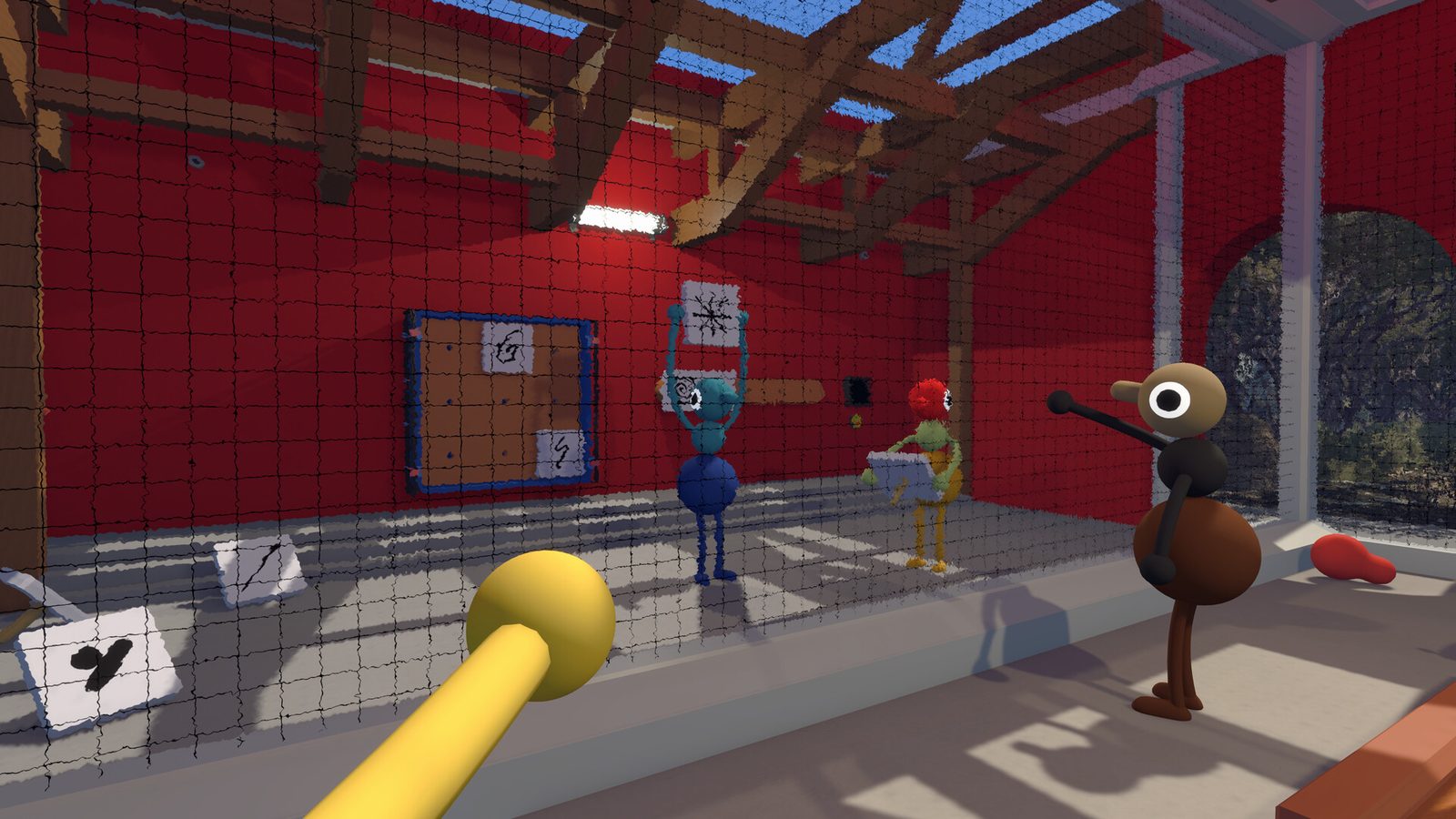
Big Walk supports two to twelve online players, but every headcount feels different. Puzzles scale down for smaller groups, while large lobbies still encounter challenges authored for roughly four simultaneous solvers. Understanding those differences prevents frustration when your twelve-person Discord squad crams into a room meant for focused teamwork.
Baseline design: the four-player puzzle
Preview coverage and launch reviews consistently describe Big Walk’s puzzle authoring as four-player centric:
- Logic gates, switch counts and information splits assume about four active brains.
- Smaller groups receive scaled-down variants so duos are not soft-locked.
- Larger groups must self-organize — some players solve, others scout, others meme with megaphones.
Two-player sessions
Duo play is the focused co-op experience:
- Puzzle feel: scaled-down variants keep duos solvable without a third or fourth brain.
- Voice and tools: proximity chat becomes intimate; one walkie-talkie is usually enough.
- Pacing and tone: slower, more atmospheric — the closest the game gets to a quiet walking adventure.
- Common pitfall: both players exploring opposite directions means nobody hears the flare.
Four-player sessions
The intended balance:
- Puzzle difficulty matches the authoring baseline — no scaling surprises.
- Tools cover the classic set: walkie-talkie, flare, binoculars and a flex slot.
- Voice channels stay manageable; four is the natural size for radio-net discipline.
Twelve-player sessions
Beautiful chaos, but it needs structure:
- Redirect extras to scouting or tool-courier roles instead of everyone touching every lever.
- Puzzle sections may feel crowded; rotate who solves so everyone gets a turn.
- Voice chat requires a co-host or a strict “walkie-talkie only during puzzles” rule.
Mid-size groups: 6 and 8 players
Six to eight is the sweet spot for large hangouts:
- Two concurrent solve teams can split around one puzzle.
- Scout roles become genuinely useful for map navigation.
- Tool duplication matters — carry two walkie-talkies or flares instead of one.
Size behavior summary
| Party size | Puzzle feel | Voice style | Best for |
|---|---|---|---|
| 2 | Scaled-down, intimate | Quiet, personal | Story focus & calm exploration |
| 4 | Baseline difficulty | Focused radio net | The intended puzzle balance |
| 6–8 | Split teams | Organized chatter | Friend-group hangouts |
| 12 | Self-organized chaos | Needs moderation | Big Discord events |
Choosing the right size
Pick your party size by goal:
- Story focus and quiet exploration → 2
- The intended puzzle experience → 4
- Large friend-group hangout → 8–12
Crossplay considerations: larger mixed-platform groups rely on Join Codes, and the host’s save carries everyone’s progress — see the hosting guide for lobby management.
Whatever the headcount, the host picks the world version (2-player, 3-player, or 4+-player) at session start — treat that choice as a commitment for the whole walk.