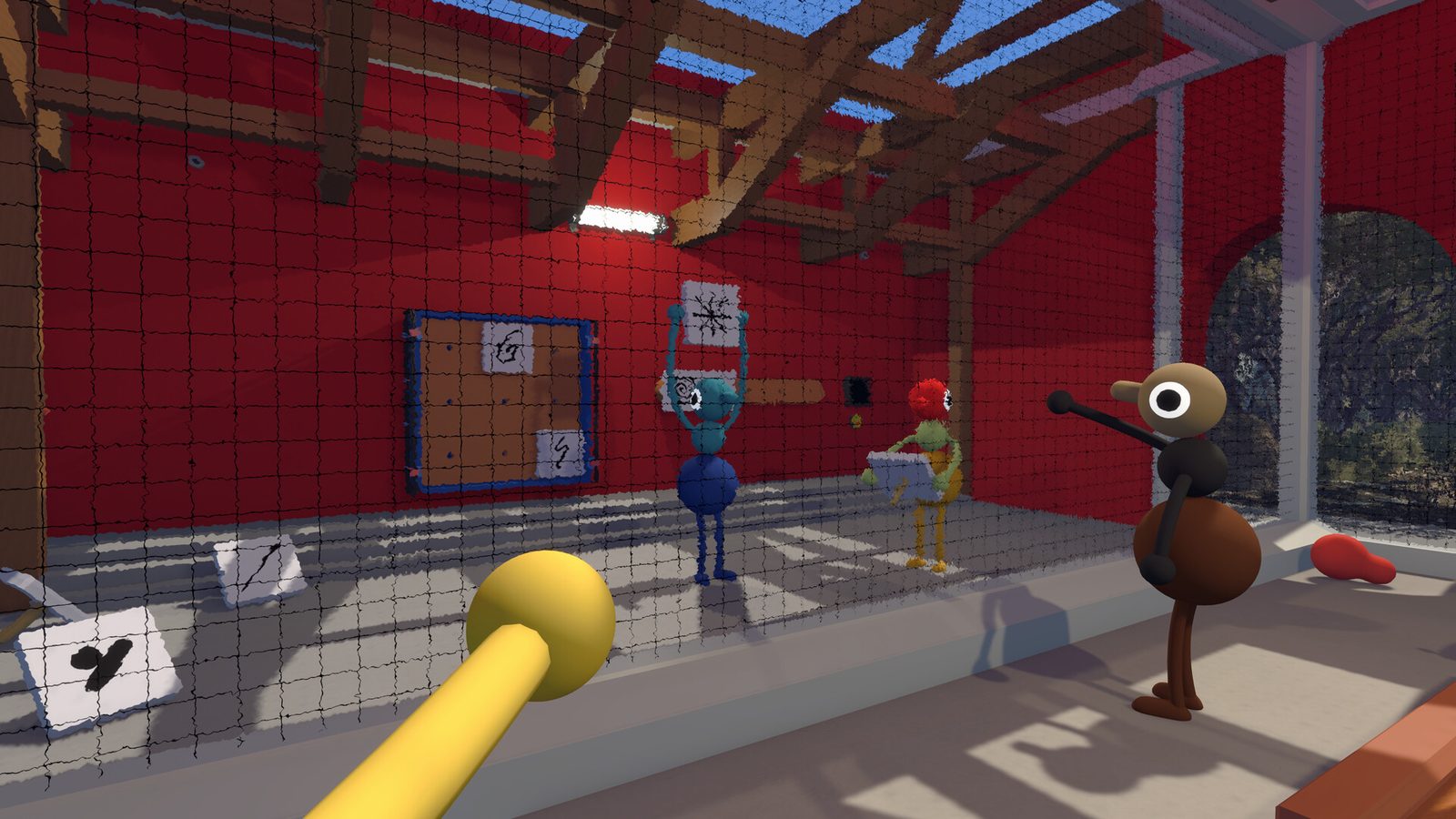
Big Walk is most fun when the group is coordinated, and coordination starts before the walk begins. Backpack space is limited, proximity voice fades with distance, and a few puzzles silence speech entirely — so the five-minute loadout discussion before each session decides whether your group splits cleanly or loses its walkie-talkie to whoever grabbed the golden head.
The loadout floor
Every sub-team that can walk away from the main party needs these three covered:
| Tool | Minimum count | Why it is non-negotiable |
|---|---|---|
| Walkie-talkie | 1 per sub-team | Proximity chat fades quickly; radios restore structured contact |
| Signal flare | 1 per sub-team | Answers “where are you?” faster than descriptive landmarks |
| Binoculars | 1 per party (2+ for large lobbies) | Lets scouts confirm gates and puzzle hooks before the group commits |
Add a whiteboard when a puzzle involves soundproof glass or long notation chains, and treat megaphones, lanterns and cowbells as optional upgrades — nice to have, never the reason a plan fails.
Loadout by group size
2 players — the light pack
- One walkie-talkie between both players.
- One flare, carried by the player who tends to wander.
- One flex slot: binoculars if you split to scout, whiteboard if you plan long puzzle sessions.
4 players — the intended balance
- Two walkie-talkies, one per pair.
- One flare on the designated regroup caller.
- Binoculars on the scout; whiteboard on the solver if the night includes silence puzzles.
6–8 players — split teams
- Two sub-teams of 3–4. Each team gets one walkie-talkie and one flare.
- Binoculars are genuinely useful here — scouting ahead becomes a full-time role.
- Duplicate the flex tools instead of sharing: two whiteboards if you plan parallel puzzles.
12 players — structured chaos
- Split into three sub-teams of 4 or four teams of 3.
- Every sub-team has its own walkie-talkie and flare; appoint a voice lead per team.
- One dedicated courier per team carries spare tools between groups, so a single spawn-side disagreement does not strand the whole lobby.
Role templates
Handing tools to roles beats handing tools to people:
- Host — carries the walkie-talkie and the group’s save responsibility; stays near the main path.
- Scout — binoculars plus a flare; walks ahead, confirms the route, radios landmarks back.
- Solver — whiteboard and lantern; owns the puzzle notation and stays with the puzzle.
- Courier — a spare flare and flex slot; ferries tools between teams when the group splits.
- Voice lead — only needed at 8+ players; moderates radio chatter during puzzles.
What to do when tools are scarce
Big Walk expects a few people to grab random toys before anyone assigns roles. If the walkie-talkie is already taken:
- Trade at the next checkpoint — inventory moves freely between players.
- Default to the flare as the regroup signal and rely on proximity chat for short hops.
- Keep one player on a watch-out role so nobody walks into a silent-puzzle room without the whiteboard.
Quick checklist before you launch
- Every sub-team has a walkie-talkie and a flare.
- Binoculars are on the scout, not the memer.
- The solver knows where the whiteboard is.
- One voice lead is named for lobbies of 8+.
- Everyone knows the regroup plan if the party splits.