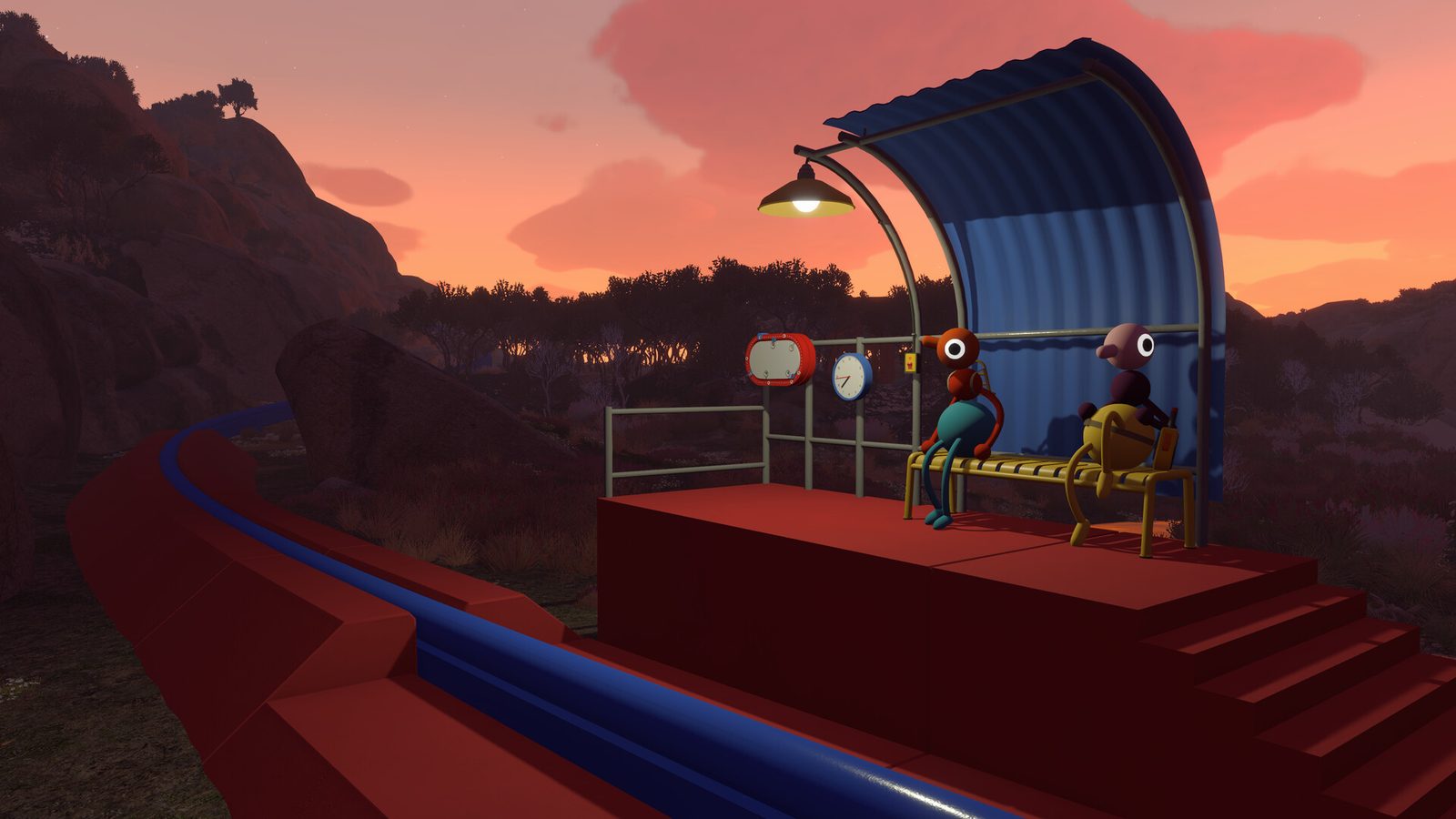
One role: the Walker
Big Walk does not give you a hero to level, a class to pick or a roster of named characters. Every player is a walker — a person in a colourful outfit who joins the same cooperative journey as everyone else.
The interesting distinction in Big Walk is social, not mechanical. Public material focuses on the toolkit every walker shares:
- Two arms you control independently (point, wave, carry, push)
- Voice and text chat
- Gesture signals
- Backpack space for found tools
- The ability to split up and regroup across the map
There is no “sniper class” or “tank build” to unlock. A twelve-person group works because players decide who carries what — not because the game assigns roles.
Can you customize your character?
Not confirmed. Here is exactly what the evidence supports:
| Claim | Status |
|---|---|
| Build assets reference body, head, torso, legs, colours and worn presentation effects | Reported in launch-week build inspections |
| A character creator or outfit menu ships in v1.0 | No first-party confirmation |
| Customization changes gameplay | No — even if looks are customizable, nothing suggests mechanical effects |
The asset names tell us the framework for a customizable walker probably exists in the build. But a database entry that says “yes, there’s a character creator” would be over-claiming — the developers have not said so, and public descriptions do not mention one.
Does Big Walk have classes or abilities?
No. Official descriptions of the co-op experience never mention classes, loadout abilities or skill trees. The closest thing to a “build” is the informal division of labour your group chooses:
- Host — owns the save and controls invite codes
- Scout — goes ahead with binoculars to check the path
- Solver — carries the whiteboard and works through puzzles
- Courier — runs items between split-up teams
- Voice lead — coordinates on the radio when groups separate
These are player-made roles, not game systems. See the party planner for loadouts by group size.
How players tell each other apart
With no character classes, identification comes from behaviour and position:
- Voice — proximity chat means you recognise who is near you
- Gestures — pointing, waving and the gesture vocabulary from the controls guide
- Tools — “the player with the flare gun” is a useful callout
- Position — a separated teammate is found by walking towards their voice or radio signal
Why there is no character roster yet
A wiki should not invent a roster to fill a category. Until House House names individual characters — or until a repeatable in-game character distinction is documented — the honest answer is: Big Walk has one walker, not many heroes. When official information changes, this page will be updated with sources.
Characters and multiplayer
The “character” system, such as it is, exists to support co-op communication, not competition. Players are distinguished by how they cooperate — which is exactly the design idea behind the voice chat and host-saves systems. In a full lobby of twelve, the question is never “what class are you?” but “who has the walkie-talkie?”